
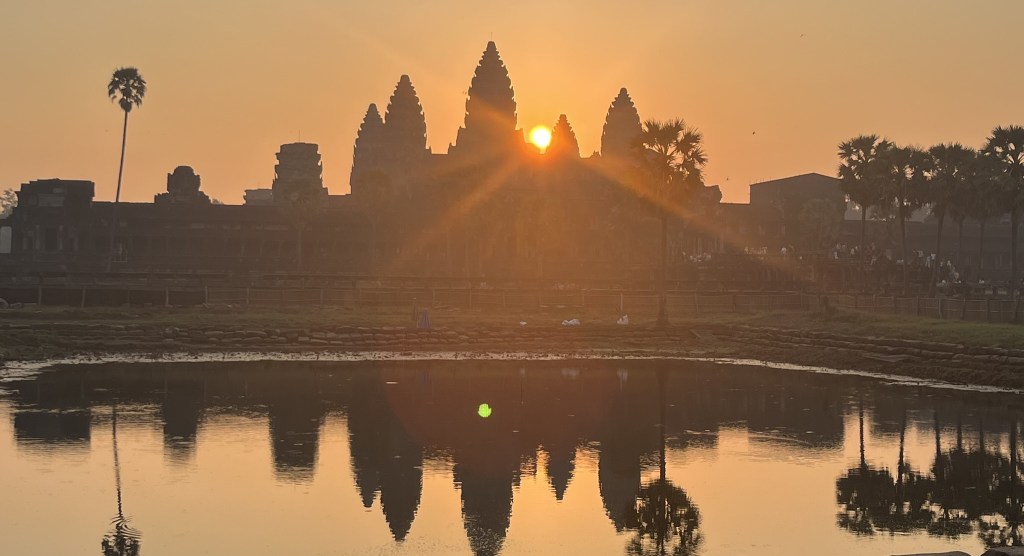
We had no idea what to expect when we planned our trip to Cambodia.
We knew little about the history as we were both children at the time of the Khmer Rouge Genocide between 1975 and 1979, in which 1.5 – 3 million innocent people were murdered. The Khmer Rouge’s interpretation of Maoist communism, and their desire to turn everyone into agricultural workers – meant that families and their ties were destroyed. The intellectual middle classes were seen as a threat; schools and universities were closed, and teachers, lecturers, and civil servants were murdered first. The impact of this horrific genocide in Cambodia’s glorious history – still has major repercussions on the country today.
If you are planning to visit, it is well worth doing a little history homework beforehand. A good beginner’s guide is the first of Loung Ung’s trilogy of life during this period, First They Killed My Father – and the 2017, harrowing film of the same name. Equally powerful is the 1984 film, The Killing Fields that chronicles the real-life experience of a New York Times journalist, Sydney Schanberg and a Cambodian photographic journalist, Dith Pran, at the start of the Khmer Rouge’s reign of terror. Both will give you a glimpse into life in Cambodia before the Khmer Rouge and during the regime.
Cambodia’s tourism industry is still in its early stages, but it is very keen to expand and has an enormous amount to offer – breathtaking scenery, ancient history, temples, culture, and diverse landscapes. We absolutely loved it. And one of the reasons we loved it so much was the people. I know reviewers say this whenever they visit a new country – but seriously we have never met such genuine and warm locals, even though many still face challenges and poverty.
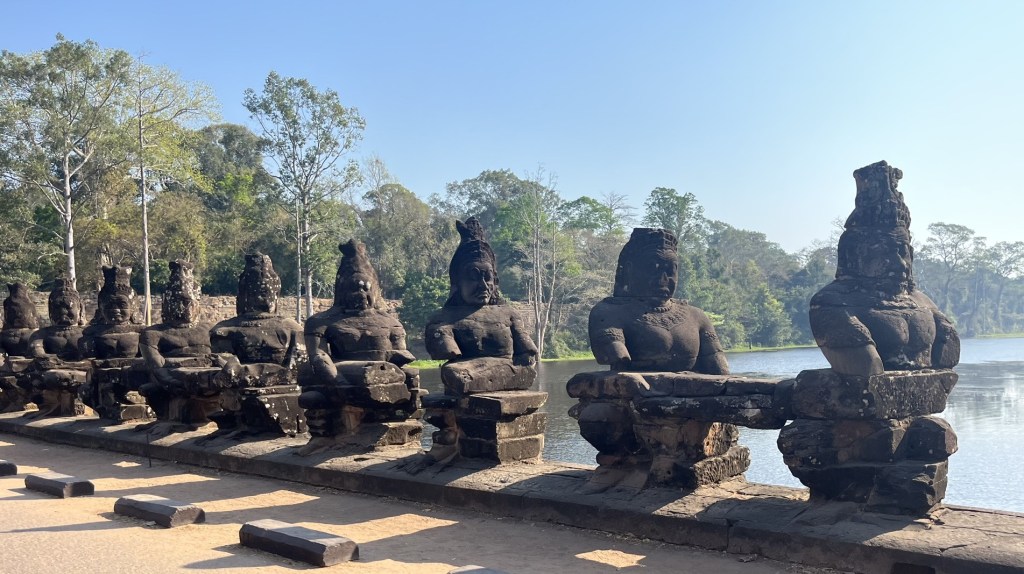
Cambodia – things to consider
- VISAs. You need a VISA to travel to Cambodia. You can apply online at Gov.Uk or when you arrive. Applying online is easy, and you simply show it when you go through passport control. At the time of writing this, Visas were £28.50. It’s very simple and easy to do.
- Currency. In 1980 following the genocide, authorities reintroduced the Cambodian Riel. £1 is approximately 5,337 Cambodian Riels (KHR). However, most tourists bring American dollars to Cambodia, and these can be used in shops, hotels, given to local guides etc. However, when you get your ‘change’ it will undoubtedly be in riels. So, a good tip is to have a reliable cash convertor on your phone as you will constantly be converting pounds to dollars to riels. The Cambodian riels are also large notes – 50,000 to 100,000 notes are the norm – so it is easy to trip up when giving tips at restaurants or not being able to check your change properly.
- Dress code. As with all South-Eastern countries, you may visit temples, places of worship or in Cambodia’s case – memorials. It is important that you dress appropriately, covering shoulders and knees. See our ‘Essential packing’ blog for ideas on what to bring.
- Travelling around. This is pretty straightforward if you are sensible. Many locals ride their scooters and motorbikes everywhere and tourists are often encouraged to hire them. Think carefully about this. Make sure that you have appropriate insurance (remember alcohol in your system negates your insurance). Make sure the bikes are in good condition – the bikes of most locals are a patchwork of parts they have acquired over the years. The roads in towns are completely saturated with traffic and in the countryside abundant with potholes. We downloaded Grab onto our phones – South-East Asia’s version of Uber. Unlike Uber, you pay the driver directly in cash. So, you book on your phone – it gives you a price – you pay them that fee at the end of the journey. It’s very economical. You can get public coaches – we did – though we did avoid night coaches – more because of accidents on the poorly maintained roads than anything more sinister.
- Tuk Tuks. Cambodia’s version of a ‘tuk tuk’, is a two wheeled carriage attached to a motorbike. They are officially called ‘moto-remorque’, or simply ‘remorque’, but most people allude to them as tuks tuks. They are safer than riding a bike, great fun, breezy in the heat and super cheap. Negotiate a price with the driver beforehand. The ones outside attractions/hotels are slightly more expensive but sometimes the drivers speak better English – so easier to negotiate price and navigate the route. Ones affiliated with the hotel will be safer as they will not want to lose their ‘contract’. Negotiating road names is more difficult – better to give names of hotels or tourist attractions. Keep your wits about you – don’t go to any diversions – tourist shops and the like and beware of bag snatching from scooters. ‘Motodops’ – scooter taxis – are very dangerous – you get on the back, no helmet – avoid like the plague. We used tuk tuks relentlessly!
- Cash is King. Make sure you arrive with enough American Dollars – you will soon have pockets of Cambodian Riel (KHR) in your pockets. Cambodia takes cards more readily than Thailand – but it is always good to have cash for Tuk-Tuks and the like.
- Distances. Don’t underestimate the distances you will travel between places. Think carefully about the pros and cons of flying versus coach or taxi. We took a long coach trip, about 6 hours, and it was great – we saw lots of rural Cambodia and stopped at some fun roadside establishments on the way!
- Impact of COVID-19. The Cambodian government has made strides to reduce poverty and improve education. Statistics from the World Bank suggest that in 2007, almost half were living below the poverty line to about 13.5% in 2014. According to the United Nations Development Programme, this increased to 16.6% in 2022. A huge percentage of the population still live on 3 US dollars a day. So, poverty is still very real for many Cambodians – particularly those living in rural locations and particularly since the pandemic.
- We felt completely safe in Cambodia but there are a couple of scams to avoid. With poverty so rife, it is hardly surprising that many Cambodians do all they can to earn enough to feed their families – with many working exceptionally long hours and doing multiple jobs. The tourist industry is a welcome financial boost to the lives of many locals, who are benefitting by obtaining work in this sector.
However, there are some specific scams to be aware of – some involving children or animals. You may be approached by a child with a baby and an empty bottle, asking if you will buy them some baby formula. You agree. When you go into the shop – you will notice a huge pile just inside the door. You buy the baby formula and leave, feeling good about what you have done. This transaction happens continuously throughout the day – with the child being given a refund (minus a reward for the cashier) on the baby milk. Also, be aware of overly friendly strangers who approach you. This is hard as most Cambodians are so warm and genuine. However, if a stranger approaches you and offers to take you somewhere, an attraction, their home, a game of cards – it probably isn’t wise to go. As you would in any major city anywhere in the world, lock your valuables in the hotel room safe, be careful of your handbag/phone when walking on the streets – scooter theft and pickpockets can be rife and avoid back street ATMs. Saying all of this – we had a perfectly relaxing, wonderful and safe experience in Cambodia.
- Do Not Visit or volunteer at orphanages – this is ‘child tourism’ at its worse and is prolific across many developing countries. Orphanage tourism or ‘voluntourism’ has grown exponentially. Most orphanages are in tourist hotspots and are a great way to attract foreign funding. We believe we are doing something to help – while in fact – we are exacerbating the problem. Orphanages have increased by 75% since 2005 in Cambodia, with 80% of the children not orphans just children from poverty-stricken families. If you want to donate, do so to charities in the UK that help community projects in developing countries, empowering families.
- Avoid any tourist attractions involving elephants. We love elephants – many of us do. South-East Asia has seen a massive decline in wild elephants and many that worked on the land in industries such as logging. Instead, many elephants today are exploited for the tourist trade. Animal welfare charities have highlighted the terrible treatment many of these elephants experience and the horrific ‘training’ programmes, baby elephants undergo in order to perform for the tourists. If you are in any doubt about how baby elephants, stolen from their herd, are trained for the tourist trade you can see the cruelty of ‘elephant crushing’ or ‘training crush’ on the internet. Fortunately, riding elephants has become increasingly unfashionable lately. A recent, high-profile case of a young traveller in Thailand, killed by an elephant while she bathed him – might also discourage travellers. If you are an animal lover like us – be very wary of elephant ‘sanctuaries’. There are a small number of truly ethical sanctuaries in South-East Asia – most that come with an appropriately high price-tag. Sadly, many more that pass themselves off as ethical while in reality are still beating and bullying these beautiful creatures into submission. Do your homework carefully and book in advance. If tourists stopped paying to ride and bathe elephants – we could stop this cruelty.
Getting there
We flew in and out via Bangkok, which is a ‘flight hub’. We chose to stay for a couple of nights in Bangkok to get over our jetlag, before flying to Siem Reap. See our blog on what to do in Bangkok.
We flew from Bangkok to Siem Reap-Angkor International Airport. This new airport opened in November 2023, and the original one, Siem Reap International Airport closed. Some internet information still talks about Siem Reap International rather than the new one. Be aware that the new airport is approximately 45 KM (about a 60-minute drive) to Siem Reap city. There is a shuttle bus – 10 times per day between 8am and 10pm – approximately 8USD each way. If you arrive late at night like we did, you are at the mercy of taxis or private hire. The internet says around 35 USD one way – we were quoted more at the airport and ended up sharing the cost with an American Ex Pat. He lives in Siem Reap and was a font of knowledge, which he was happy to share. Budget accordingly so you don’t start your trip with a hole in your cash reserves. This was the most exorbitant expense about our visit to Cambodia.
Siem Reap – What to do in Siem Reap
Siem Reap is the second largest city in Cambodia and the capital of Siem Reap Province. The majesty that is Angkor Wat and the surrounding temples and palaces, is what attracts over two million visitors every year. But Siem Reap is also a remarkable place to learn more about Cambodia’s history, savour its range of restaurants and bars, enjoy the vibrant night scene on Pub Street and marvel at the remarkable and unmissable, Apopo visitor centre.
This is what we did in Siem Reap
- We arranged through our hotel, at very little cost, a personal – whole day guided tour of Angkor Archaeological Park. Extending over 400 square km, this UNESCO World Heritage site has the capital city remains of the different Khmer Empires from the 9th to the 15th century.This includes the temple of Angkor Wat, Angkor Thom and the Bayon Temple (used in the 2001 Lara Croft Tomb Raider film.)
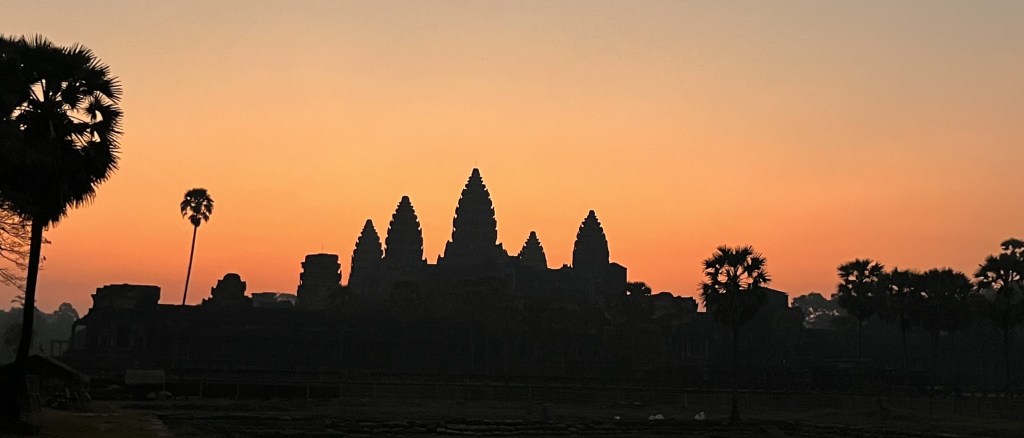
We were picked up at 4am by our guide and a tuk tuk driver. We travelled through meandering, pitch dark lanes, with just the loud, cacophony of the surrounding jungle for company. We parked up and silently followed the guide as he navigated us on foot across pitch-black fields and lanes. Finally, we stood in the bleak, chill night and waited. Through the gloom, the silhouettes of other visitors loomed around us. People whispered in excited anticipation, standing patiently waiting for the unknown ‘show’ to begin. When it began, slowly, deliberately, the sun took its time, painstakingly rising behind the majesty that is Angkor Wat’s splendour.
This was just the beginning of the day. We spent several hours exploring Angkor Wat, marvelling at its beauty and listening to our guide explaining the history of these noble dynasties. Then the tuk tuk picked us up and whisked us off to an impromptu picnic lunch provided by the driver. In the afternoon, we explored some of the other palaces and temples. Being on a private tour meant we could decide where and for how long. It was very hot, and the guide knew exactly where we could visit to escape the harshness of the sun.
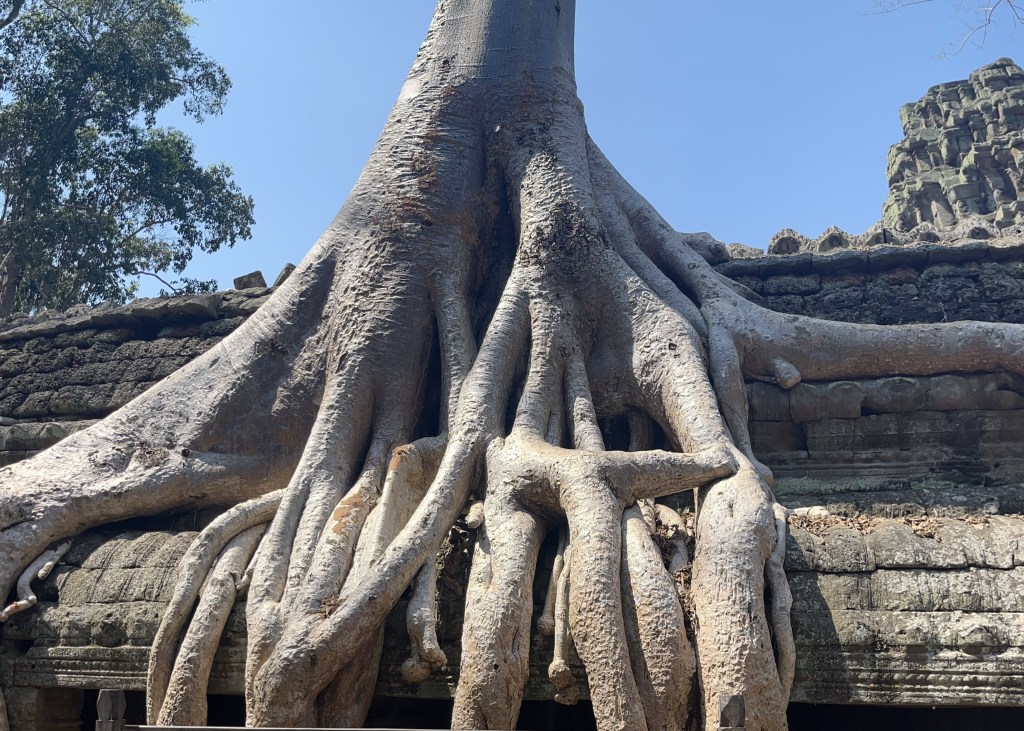
We loved the smaller temples and had great fun at the Bayon Temple, where the jungle has tried to claw back its land, eating into the buildings.
You can just visit Angkor Wat – but you would miss out on so, so much.
Of all of our worldly travels, we both felt that this was probably one of the most spectacular places we have ever experienced or explored – on every level and at every point. The 4am start felt harsh, but oh my goodness, so worth it. Having a private guide gave us total flexibility and was exceptionally cheap for the day that we had and what we saw and learnt.
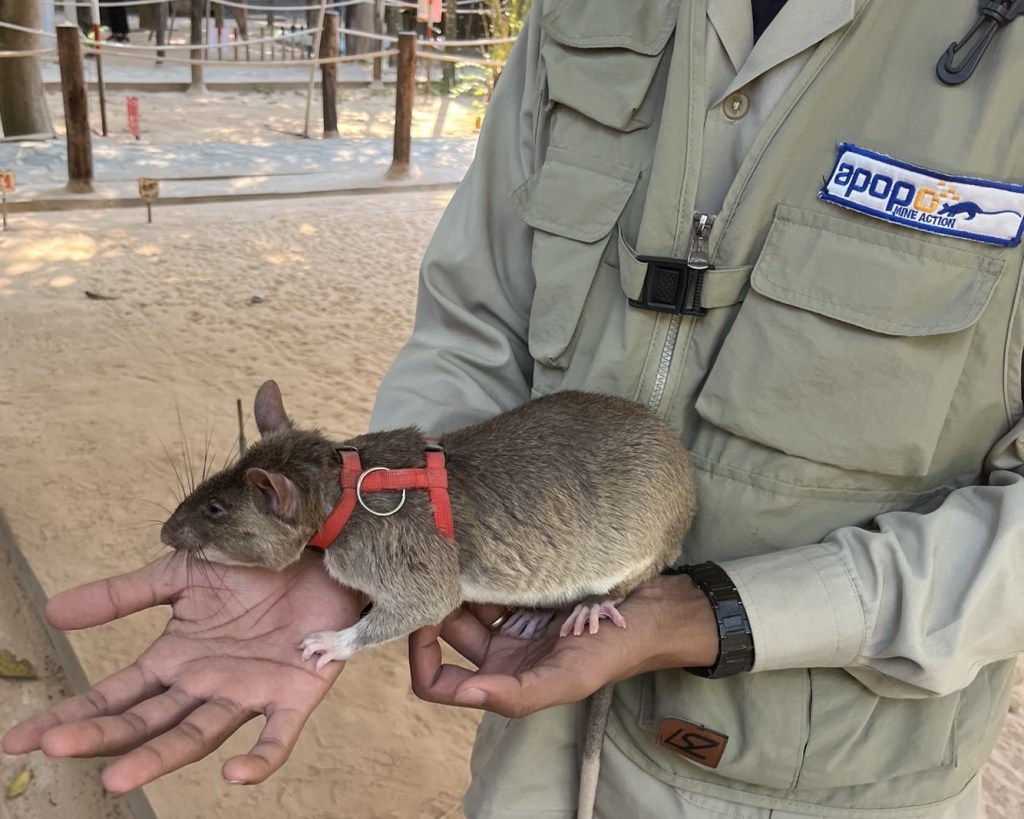
- We went to the APOPO Visitors centre. A short ride from the centre of Siem Reap is the Apopo Visitor centre. Cambodia still has 4-6 million unexploded landmines and bombs blighting the landscape and posing a serious threat to the population. Many Cambodians continue to be killed or maimed each year and whole sections of land lay unused due to this imminent danger. These mines/bombs, were left by the Americans during the Vietnam War, and the Russians and Chinese during the Khmer Rouge period and subsequent Civil War of the 1980s. Much is being done to try and prevent death and injury and reclaim land – but it is painstaking and dangerous work. At the Apopo centre they train African-born HeroRATS to literally sniff out the landmines. This is an extremely effective way to clear large sections of land efficiently. At the Apopo Visitor Centre, you can spend 1-2 hours finding out about their work – seeing the rats in action and if you are brave enough – holding them. More importantly, your entry ticket and gift shop purchases – support this work to continue saving lives. With the USA cutting its foreign aid to projects like this – they will become increasingly reliant on tourists like us. You do not need to go on an expensive ‘tour’ – just book a slot directly online – at the time of writing it was 10USD per adult, children under 10 are free and jump in a tuk-tuk from the centre of town.
- Pub Street. Many towns and cities in Cambodia have a ‘Pub Street’. This one is particularly vibrant and bustling. It’s pedestrianised after dark when it comes alive, with cafes, restaurants, bars, dancing and girls. It’s good fun for a couple of hours in the evening. Keep an eye out for the huge bats that hang around in the trees around Pub Street – many are fruit bats – Lyle’s Flying Foxes. They are numerous and very entertaining to watch, though I wouldn’t get too close.
- Restaurants. Siem Reap has an increasing number of very good restaurants – though you will need to plan and book ahead. We rarely give restaurant recommendations but have made an exception here, as we discovered a place called HAVEN, run by a Swiss couple Sara & Paul Wallimann. Check out their website to find out more about their story. https://havencambodia.com/
Essentially, ‘HAVEN is a social enterprise and a training restaurant for vulnerable young adults from shelters, as well as underprivileged young adults from very poor rural areas.’ The service is impeccable, the food amazing, the prices very reasonable and the atmosphere wonderful. What’s not to like!
Phnom Penh – What to do in Phnom Penh in two nights three days.
Phnom Penh is the capital of Cambodia. Sat on the banks of the Mekong River, Phnom Penh is steeped in history and is a great place to learn, explore and savour Cambodian life.
Getting there
We travelled by coach from Siem Reap to Phnom Penh. Run by different companies, coaches are very regular and very cheap – the journey taking 5-6 hours. Check reviews on the different coach companies – we chose one slightly more expensive because it had great reviews – you don’t want last minute cancellations, luggage going missing or delays! We chose to travel during the day for two reasons – firstly, so we could look at the scenery and two, because some of the roads aren’t great for night-time driving. We opted to do this rather than flying because we thought it would give us an opportunity to see some of the more rural parts of Cambodia, and we weren’t disappointed. The coach was pretty comfortable – some great fellow travellers onboard and several stops at roadside rest stops where you could buy all manner of interesting things.
This is what we did in Phenom Penh
On our first night, tired from the journey, we ambled through the busy streets of Phnom Penh, soaking up the atmosphere on the Riverfront Promenade and sipped cocktails in a rooftop bar as the sun went down. It is a great city to explore and easy to get around – most tuk-tuks charging 1-2 USD to get to local places.
We stayed in a beautiful colonial hotel that used to be the American Embassy, which was a great place to relax following a hectic day avoiding the traffic and scooters.
Day One – Choeung Ek (The Killing Fields) and Tuol Sleng Museum of genocide
We booked a local tour of Choeung Ek (The Killing Fields) and Tuol Sleng Museum of genocide. Both of these are not to be missed if you want to find out more about Cambodia’s history. Be aware, both sites are quite traumatic and continue to be memorial sites. Dress appropriately. We decided not to take photographs, out of respect for the millions that were murdered at these and many other sites. This was an incredible way to learn first-hand, the atrocity of genocide and the impact of this bloody part of Cambodia’s history. The tour included transport from our hotel and a guide and was very reasonable in terms of cost. We were lucky to have a very knowledgeable and respectful guide, who gave us pertinent information but also time to quietly explore and reflect. If you don’t take a tour, you can also hire the audio guides which are excellent. Avoid the hot sun by starting early – both sites are outdoors.
The former M – 13 prison, Tuol Sleng Genocide Museum (former S- 21 prison) and Choeung Ek Genocidal Centre (former Execution Site of S-21) have been preserved as memorial sites that demonstrate the horror of Pol Pot and the Khmer Rouge regime. You can read the full history on the UNESCO site, and they have now been nominated for World Heritage classification.
Choeung EK is one of many killing fields in Cambodia and is still an active archaeological site. It was once an orchard, before being used as a mass execution and burial ground for prisoners, particularly those tortured at the notorious S-21 prison. Most were killed using pickaxes, knives or bamboo so as not to waste bullets and many human remains continue to be found today. Of particular note is a tree, ordained with ribbons and baby toys, where once tiny babies were murdered in front of their distraught mothers. A Buddhist memorial stupa sits at its centre, full of human remains and clothing found at the site. Approximately 8,895 (source WiKi) have been found on this one site alone. We found our time here very upsetting and moving. It is a very quiet, tranquil memorial site and we made a point of not taking any photos out of respect for the thousands brutally killed and buried here. We went to the Killing Fields first to avoid the midday sun.
Tuol Sleng Museum of genocide is based in an old school back in town. This is one of approximately 200 detention and interrogation prison across Cambodia during the Pol Pot regime. Classrooms were turned into cells, the gym and playground into a torture chamber. In 1976, 17,000 were incarcerated, documented, tortured and eventually killed either at the prison or in Choeung Ek – only seven managed to survive. On some days, one or two of these seven survivors, are there and will sign their books and have their photos taken for a small price. The museum has retained the prison cells and has a large exhibition of the photos taken at the time of incarceration. It is a sobering reminder of the true horror of this genocide.
Riverfront Promenade is a lovely place to wander and people watch in the evenings, while soaking up local customs and culture. It has lots of stalls selling local delicacies, locals working out in the outdoor mini gyms (old and young) and families strolling. You can walk along the front to the night market at Phsar Reatrey or simply cross the road and find somewhere interesting to eat. On our second night we walked and explored, buying some great local food and eating it on a balcony overlooking the bustling street below.
Caged birds and Buddhist ‘mercy release’. Millions of birds are caught each year, sold and then released in return for good luck. You will see children and their families, walking up and down with cages full to bursting with small birds such as swallows and sparrows, which they sell to those promenading, who then set them free. On Holy days, Buddhists buy fruit and flowers for offerings, donate food to monks, meditate and light candles and incense. ‘Mercy release’ of small birds is seen as another element. We found the practise exceptionally disturbing and upsetting. Many of these tiny birds flap about in abject fear and panic, are quiet or are dead. There are calls for this practice to be stopped.
Be aware that the red-light district has several roads opposite the promenade, with many groups of young women. In our experience, the bars adjacent to the explicit red-light district roads, were sadly filled with lone European men. In one, I was the only woman and watched as individual European men arranged their evenings on their phones, negotiated prices and were whisked away on bikes and taxis. It felt like we had stumbled on the more sinister side of the trade in very young women, unlike the more confident, groups of women calling out for trade to passersby in the ‘girlie bar’ streets.
Day Two – before heading to the airport, we spent the morning at the Royal Palace and Silver Pagoda. It is the official, current Royal Residence of the King of Cambodia and as you would imagine is opulent and spectacular. It is also a revered holy place – so be aware of the dress code – no shoulders or knees – see our Essential Travel Guide . It’s a beautiful place to while away a few hours, especially first thing in the morning – when it first opens before the sun gets too hot.
[HM1]Put your elephant piece in here

 We travel not to escape life, but for life not to escape us.